A personal statement is part of your application to study at a UK university. In a personal statement, the student writes about what they hope to achieve on a UK university course, what they hope to do after it, and why they are applying to this particular university. It is your first chance to show a demonstrable passion and understanding of your chosen subject away from exam results.
If you wish to begin studying in the UK in 2025, you must complete a personal statement. If you plan on studying in the UK from 2026, a new format of personal statement is being introduced by UCAS. See below for more details.
Personal Statement EditingSI-UK will edit your personal statement and ensure the English is clear and grammatically correct. Arrange a free consultation with SI-UK London to learn more.
Genuine experiences of extracurricular clubs, work experience, or knowledge around a subject are much more likely to make your personal statement stand out. Admissions officers are also looking for positive evidence of your character, which will make you a productive member of the university.
The length of a personal statement varies depending on the university, but generally, the average length for an undergraduate application is between 400 and 600 words, around one side of A4 paper or a maximum of 47 lines. Certain postgraduate programmes may require a 1000-word personal statement, but this will be specified.
Try not to exceed the given character limit. Admissions officers have many personal statements to review, and a clearly written and concise personal statement is more likely to stand out.
It is also important not to lie about any aspect of your personal life and education history or even exaggerate. Admissions officers will question you about almost all aspects of your application and will be able to see through any lies.
In terms of presentation, attempt to create five clear paragraphs of text in a clear font such as Arial or Times New Roman, with a maximum size of 12.
Starting from September 2025, the traditional UCAS personal statement will be replaced by three mandatory questions. The new questions will be:
If you have any questions about how the changes may affect your application to study in the UK, do not hesitate to contact the SI-UK team today.
Once you have completed your personal statement, arrange a free consultation with SI-UK London. We can edit your personal statement and ensure the English is clear and grammatically correct. Once this process is complete, we will return it within 1-3 working days.
Applicants should avoid misspellings and grammar errors and discuss topics unrelated to their application and character.
Yes, universities read UCAS personal statements, and they play a major factor when shortlisting candidates.
If you lie on your UCAS personal statement, your application will be rejected, and any offers will be revoked.
If UCAS detects similarities in your personal statement, it will be flagged for review, and your university choices will be notified while it is under review.
UCAS will notify you if your UCAS application has been rejected. You may also receive an email from the university stating why your application has been rejected.
Once your UCAS application has been submitted, it cannot be changed. So, before submitting, make sure you proofread your application or get it proofread by someone else to make it error-free.
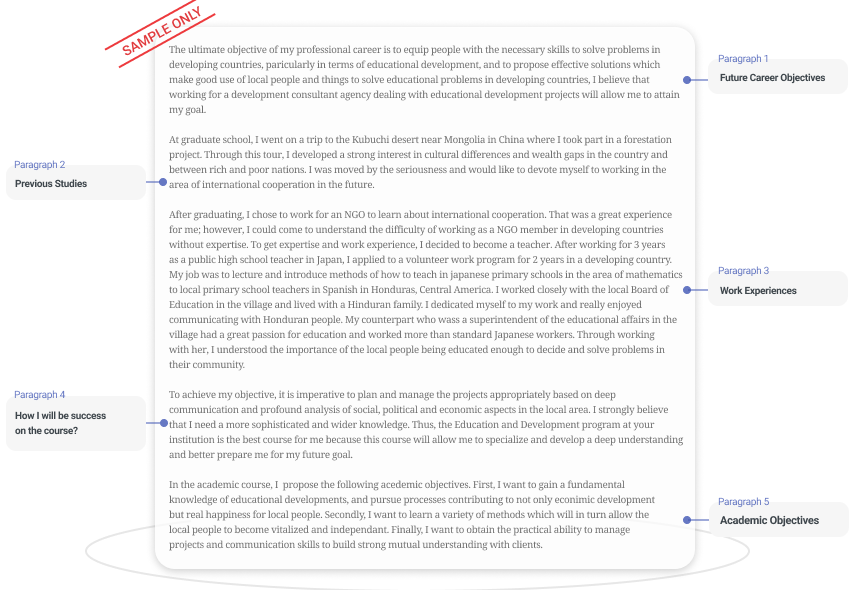
Please see below for an example of a personal statement to a Development Studies course.
